Route 66 Matchbooks and Matchcovers
I have been collecting matchcovers from businesses located on Route 66 for almost thirty years. I like matchcovers very much but quite frankly I prefer postcard souvenirs. After all a postcard is not only a souvenir from a Route 66 business but it also has a nice picture of the enterprise, something that I value. Very few matchbooks were printed with a picture of the business and if one was the picture would have been a small low-resolution image. That said, matchbooks and matchcovers can make a much more comprehensive collection than postcards. Why? Well, most Route 66 businesses that had postcards for distribution had matchbooks too. But more importantly the reverse is not true. Whereas many motels offered both postcards and matchbooks, most other traveler-oriented businesses, like restaurants, cafes, and gasoline stations, only distributed matchbooks and they never offered postcards. In many cases the only way to acquire a souvenir today from these long-ago businesses is to acquire a matchbook or matchcover.
Many veteran matchbook collectors greatly appreciate the early highly-detailed and colorful artwork and style of matchbooks from the World War II era and earlier but Route 66 collectors by circumstance usually acquire matchbooks that were printed and distributed during the post-War halcyon years of Route 66. (Although not exceptionally rare, only a small minority of Route 66 matchbooks can be definitively dated back before World War II.) It was during the post-War decades that Americans traveled the highways and roadside business owners increasingly purchased custom-printed matchbooks from matchbook manufacturers for free distribution to their customers. After all, this was a time when almost half of American adults smoked and there were no restrictions on lighting-up wherever and whenever one wanted. The matchbook was a small and inexpensive advertising item that would remind the smoker about the business from which it was acquired every time that person pulled the matchbook out to use it.
Most of the Route 66 matchcover images presented on this website are from the collections of Kevin Fleming and my own. My thanks also to Mike Ward, Steve Rider and Clem Pater whose matchcover images are also displayed. And a number of the images shown here have been acquired from other internet websites.
Matchbook and Matchcover Primer
Although phosphorus matches were invented in 1836, it wasn't until the 1890s that the folded paper matchbook was devised. The matches in these matchbooks are "safety matches". That is, they are formulated such that the rubbing of the match heads against themselves will not cause them to light. Clearly if rubbing did so the matches would be self-igniting all the time. The dark gray striker material is impregnated with certain chemicals so that the head of the safety match must be struck or wiped against the striker material on the matchbook in order to light.
There is a nice website that covers the common terminology used to describe the various parts of a matchbook.
But first an important definition and distinction: a matchbook is usually considered an intact book with matches. Once the staple is opened and the remaining matches in the cardboard comb are removed and discarded - a process known as shucking - the flattened piece of light cardboard becomes a matchcover. Most collectors collect matchcovers, not matchbooks, because they are easier to store and they have less risk for degradation. Matchbooks can be problematic for collectors since the staple may rust and discolor the adjacent cardstock in humid environments and the chemicals in the match heads may break down and stain any cardstock material with which they make contact. Flat matchcovers are easier and more pleasing to display as both the front and the back covers can be seen with one glance.
The 20-strike (or 20-stick) matchbook is the most common matchbook type. It has 20 matches in the comb arranged as four rows of five matches each. As a flat matchcover the dimensions of the 20-strike matchcover are approximately 1½" by 4½". These dimensions varied a little since the matchbook manufacturers cut their cardstock differently. Probably 90% of the Route 66 matchbooks and matchcovers that I have seen are of the 20-strike variety.
The second-most common type is the 30-strike matchbook followed by the 40-strike and 10-strike matchbooks. As flat matchcovers the lengths of these types are all similar but the 10-strike matchcover is about ¾" wide, the 30-strike matchcover is about 2⅛" wide, and the 40-strike matchcover is about 3" wide.
There were many other types and sizes of matchbooks that are rarer than these most four formats. In many cases these types quickly came and went during the principal decades of matchbook manufacturing and distribution.
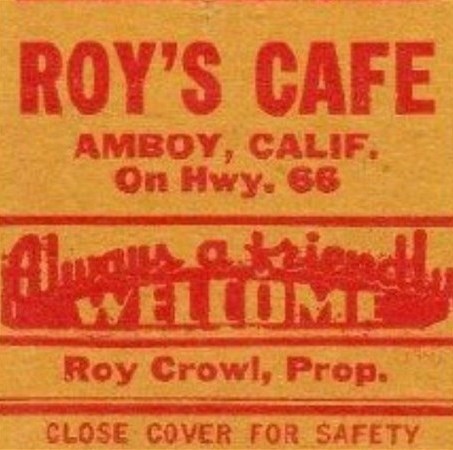
Below are some examples of Route 66 matchcovers in the four most common sizes. If you are using a computer and your display screen pixel resolution is a certain specific number, the images below and elsewhere on this web page will appear to be life-size. That is, the 20-strike matchcover below left will appear to be 4½" high and 1½" wide. But with the variety of CRT and LCD monitors at different resolutions in this world this is quite unlikely. If you are viewing this web page on a smart phone or tablet, the images are always defaulted smaller than the real thing. But, of course, you can expand the images with a spreading of your fingers. Regardless of what electronic device you are using, the images on this web page should all appear in proper proportion. That is, the height of the image of the 20-strike matchcover below left should appear to be about three times the width of the image.
(By the way, different browsers flow text and picture elements onto monitors and device screens slightly differently. I have viewed these web pages on a variety of computers and they appear satisfactory. But some small portable devices (phones and tablets) may wrap the images around page boundaries funny and, even worse, some images may not even be the correct image that goes with the caption! Serious viewers of these web pages, should they encounter images or image arrangements that do not seem right, may need to access this website from a computer. Also it may be helpful to view these webpages if the visitor turns their portable device into the "landscape" format.)

20-Strike

30-Strike

40-Strike

10-Strike
As I mentioned above, the 20-strike matchbook was by far the most popular and common type of matchbook made. As a fun example of the wide variety of artwork designs used for 20-strike matchcovers I prepared a collage of matchcovers from traveler-oriented businesses on Route 66 (Main Street) in Barstow, California. Most of these matchcover images are from the collection of Mr. Fleming.
Common matchbook manufacturing techniques of the post-War period called for a good quality thin paper to be applied (laminated) to the light cardboard stock. The thin paper became the visible outside surface (front cover, saddle, and rear cover) of the matchbook while the thicker cardboard was the substrate that provided the thickness and strength for the matchbook. The laminated outside paper surface was able to take printing inks very well, something that the cheaper light cardboard did not usually do.
As explained in the website cited above, nearly all matchbooks manufactured before the early 1970s were front strike matchbooks. That is, the striker is immediately in front of the comb of matches when the front cover is tucked in behind the striker. All of the matchcovers shown above are front strike matchcovers. Unfortunately many smokers did not heed the caution to "Close Cover Before Striking" (or similar warning) and would lazily strike a match against the striker without first closing the front cover. This was rarely a problem but occasionally the flare of the lighting match would flash over to the other match heads in the open matchbook and ignite them all in a big whoosh. A federal law forced the re-positioning of the striker to the rear cover and therefore required that the smoker to turn the matchbook over before striking the match. This change made it extremely unlikely that the remaining matches would ignite even if the cover was left open. 1973 was the year that the matchbook manufacturers could no longer make front strike matchbooks but all front strike matchbooks still in inventory or in the hands of businesses could be furnished to the public. Later in that decade this transitional period was considered complete and all matchbooks were rear strike. Most Route 66 matchcovers are therefore front strikers since large segments of U.S. Highway 66 had already been de-signed or de-certified in favor of the nearby interstate highways by the 1970s when the rear strike matchbook began replacing the front strike matchbook.
Here is a side-by-side comparison of an older front strike matchcover and a newer rear strike matchcover from the same business. The striker on the rear-strike matchcover on the right has been moved about ½" in from the edge of the cardstock so it is part of the rear cover when the matchcover is folded back into the form of a matchbook.

Older Front Strike Matchcover

Newer Rear Strike Matchcover
The example above also presents several clues other than the striker position that help determine the age of a matchcover. To an experienced matchcover collector it is obvious that the text type and the stock illustration "Approved MOTEL All Conveniences" is much older than the modern stock block "THANK YOU" . But there is more. First, notice that the name "PIÑON LODGE" is used in the older matchcover while the more modern name "PINON MOTEL" is used in the newer matchcover. Second, the earlier 5-digit telephone number has become a later 7-digit telephone number. Third, the older matchcover promoted "Automatic Floor Furnace Heat" which I believe is what we now call electric baseboard heat, while the later matchcover promoted "Color TV" which probably did not exist when the front strike matchcover was made. And finally, the earlier front strike matchcover says that the business was "On U.S. Highway 66" whereas the later matchcover does not, implying that the interstate freeway had been completed and Route 66 bypassed Central Avenue in Albuquerque by that time. (Interstate 40 was completed around Albuquerque by 1970.) My guess is that the older front strike matchcover is from the 1950s and the newer rear strike matchcover is from the late 1970s or the 1980s.
Matchbook and Matchcover Collecting Today

The oldest matchcover collector organization is the Rathkamp Matchcover Society which dates back to just before World War II and is named for an early leader of matchbook collecting, Henry Rathkamp. Appropriately a special matchbook was printed for the first informal meeting of "Book Match Cover Collectors" in September 1939 at Mr. Rathkamp's home, as can be seen on the right. Today the Rathkamp Matchcover Society is the resource center for matchbook and matchcover collecting in North America. From this website you can link to some regional clubs around the United States and Canada. Unfortunately the number of clubs is much fewer than decades ago and some clubs have either pretty much abandoned meetings (and matchbook and matchcover exchanges) or have small meetings with a limited number of devout members attending. The hobby is still active but like some other hobbies the number of participants has sharply decreased.
Is matchcover collecting a dying hobby? There are many hobbies that were popular at one time or other and they may actively continue for decades and even generations. But some of these hobbies mature to the stage where the participants seem to be an older demographic and youthful participants seem to be few and far between. Sadly, matchcover collecting is one of these hobbies. An analysis of the historical membership rolls of the Rathkamp Matchcover Society conducted in late 2018 indicated that the number of club members had decreased by more than 75% during the previous thirty years.
In the last fifty years or so there has been one technological disruption, one significant lifestyle trend, and one regulatory movement that have pushed the custom-printed paper matchbook to near-extinction:
(1) The introduction of the small inexpensive disposable lighter decreased the demand for the once-popular paper matchbook.
(2) There are fewer smokers. Once almost half of American adults smoked but by 1980 only about one-third of adults smoked. By 1990 the number was about one-quarter and by 2010 it fell below one-fifth of the adult population. The Centers for Disease Control and Prevention (CDC) reported that fewer than 10% of American adults smoked tobacco products in 2025. (American adults who vape are approximately 7% of the population.)
(3) There are more legal restrictions on smoking that make the active smoker unwelcome in many places.
So the matchbook, once an ubiquitous advertising item given away free by many businesses, fell out of favor as a promotional item since it had far less appeal and usefulness to as many people as it once did.
The distribution of custom-printed matchbooks by businesses is rare nowadays. And some businesses may provide only plain, generic matchbooks for their smoking patrons rather than the custom-printed ones of yesteryear. (Eating and drinking establishments were once one of the largest distributors of matchbooks. But now in a number of states these same businesses are non-smoking by law so you won't find matchbooks there. In all three Pacific coast states, where I spend most of my time, smoking is prohibited by state law in nearly all indoor venues.) Foreign competition and a dying market led to the collapse of the North American matchbook industry in the late 1980s to just four matchbook manufacturers then. To my knowledge D. D. Bean and Atlas are the only two matchbook manufacturers left in the United States. (I think Diamond makes wooden stick matches in the United States.) There are no manufacturers in Canada.
Younger people have simply not been exposed to the history, variety, artwork and visual appeal of old matchbooks. There are fewer people coming into the hobby to keep the active collector population stable as the older folks pass. Matchcover collecting will always be with us but I see no reason to believe that the trend of fewer active participants will not continue for some time.
And by the way, nearly all of the collectors of matchcovers that I have met are non-smokers!
Veteran matchcover collector Loren Moore has built a fantastic personal collection around telephone numbers from 1 all the way to 9999. (More information is provided about Mr. Moore's telephone number collection and his data base on the "Themes" web page.) But of interest to visitors to these webpages, a number of Route 66 matchcover collectors joined together to upload a large quantity of Route 66 matchcover images into Mr. Moore's data base. To see 9000 different Route 66 matchcover images click here.
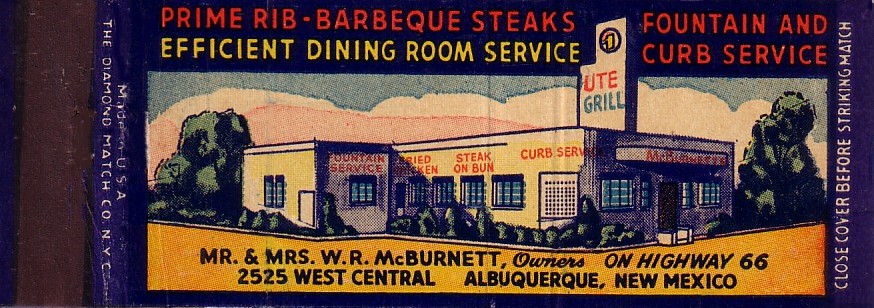
Below are picture links to five informational web pages and gallerys of Route 66 matchcovers and matchbooks. I suggest that first-time visitors click on the picture links in order from left to right.
Introduction
to Route 66
Matchcovers

Selected Themes
of Route 66
Matchcovers
Route 66 Full Length Matchcovers
Route 66
Matchcover Sets

Special Route 66
Matchcovers and
Matchbooks