Introduction to Route 66 Matchcovers
If you are viewing this web page you are probably a Route 66 historical supporter on some level, so imagine a humble matchbook being furnished by an early Route 66 business owner to a member of the traveling public many decades ago. At that time the matchbook would have been from just another one of thousands of establishments stretched out along the 2400 miles of Route 66 between Chicago and Los Angeles. But that business gained fame in these re-discovery years of the highway, perhaps for the unique architecture of the business that was not fully appreciated in the old days, perhaps for the personality or charisma of a particular proprietor of the business, or perhaps for the longevity or remarkable survivorship of the business itself. Here are seven matchcovers (one from each state except Kansas), all about fifty to eighty years old, that were distributed by businesses on Route 66 that became noteworthy locations during these revival years:

Founded as a service station and garage just before World War II by Roy and Velma Crowl, Roy's is the oldest remaining operating business between Barstow and Needles from the two-lane Route 66 era. The motel units and cafe were added at different times in the early 1950s. The flying-wedge motel office and the famous 1959 signboard are known for their classic "Googie" design style.

Frank Redford designed a guest room shaped like an Indian wigwam and several motels were built to his specifications in the southeastern USA. Chester Lewis negotiated permission to use the design for his motel on Route 66 in Holbrook, Arizona, where it continues to be operated by the Lewis family today. The Wigwam Motel was listed on the National Register of Historic Places in 2002.

Probably the most photographed of all existing motels along Route 66, the Blue Swallow Motel was acquired by Lillian Redmond and her husband Floyd in 1958 and she ran it for another 40 years. Also known for its stunning neon signboard and unique blue neon lighting around the building, the Blue Swallow Motel was listed on the National Register of Historic Places in 1993.

The Cafe U Drop Inn was built in 1936 at the busy intersection of US Highways 66 and 83. It is known today as a classic art-deco creation with the original gas station on the corner and the original café to the east. The cafe has operated under other names including Nunn's, the Tower Café, and Carrol's Bar-B-Que. The U Drop Inn was listed on the National Register of Historic Places in 1997.

This roadside gasoline station was built in 1929 by Carl Ditmore. His family lived in the small upstairs quarters. The Waldroup family bought the business in 1934, added some overnight rooms and renamed it the Provine Station. Carl and Lucille Hamons bought the Station in 1941. The motel rooms were closed soon after it was bypassed by the interstate in the early 1970s. After Carl died, Lucille (the "Mother of the Mother Road") worked the gas station herself, a total of nearly sixty years on Route 66 before passing in 2000. The Provine Service Station was listed on the National Register of Historic Places in 1997.

The Coral Court was opened in 1942 by John Carr with just 20 rooms. Two later expansions brought the motel to 75 rooms. Designed with rounded corners, glass block windows, and wrapped in two colors of special ceramic-surfaced bricks, the Coral Court was one of the finest examples of streamlined moderne architecture anywhere in the USA. After John Carr's death in 1984 the Coral Court suffered from deferred maintenance and a seedy reputation. It was listed on the National Register of Historic Places in 1989 but that did not stop its destruction in 1995 for a housing development.

Pete Adam opened the Ariston restaurant in Carlinville on State Highway 4 (later US Highway 66) in 1924. Mr. Adam opened a second Ariston in Litchfield when Route 66 moved east in 1930. Eventually the Carlinville location was closed. Except for five years in the early 1960s when it is was operated by the Boyds (hover cursor), the Ariston Café had been operated by three generations of the founding Adam family until it was purchased by new owners in 2018. The Ariston Café was listed on the National Register of Historic Places in 2006.
Many of the old restaurants and cafés along Route 66 are no more. Some have been completely destroyed and some have decayed to the point where they will likely never serve a traveler again. Don't we wish that we could grab a bite to eat at any of these places just one more time? Here are eight matchcovers (one from each Route 66 state) from recognizable businesses that are no longer with us:

The Road Runners Retreat was the most modern restaurant between Ludlow and Needles. Roy and Helen Tull built the restaurant and the adjacent gas station in 1962. The businesses operated until two-lane U.S. Highway 66 was bypassed in 1973 and they were soon was abandoned. The restaurant burned down in 2020. The spectacular neon signboard was restored and re-lit in 2025.

The Pine Breeze Inn is just east of Bellemont on an old segment of Route 66 that was bypassed in about 1963. Although this matchcover does not say that gasoline was for sale, the building itself has a canopy and a concrete island that likely supported pumps at one time. The Pine Breeze Inn made a brief appearance during the early scenes of the 1969 movie Easy Rider.

Nute Epps opened the Club Café in 1935. It was later acquired by Philip Craig and Floyd Shaw who ran it for over thirty years. During these halycon years the Café became regionally known for its "fat man" signs and its sourdough biscuits and gravy. The interstate bypass severely impacted the entire City of Santa Rosa and the Club Café which closed in the early 1990s. The building was razed in 2015.

After World War II the downsizing U.S. military sold off all kinds of surplus property and matériel. A control tower module from the Dalhart (TX) Air Force Base became the beginning of what was to be the Bent Door Café. Later renamed, Tommy's could once say that "We Never Close" but in the late 1960s Adrian and two-lane U.S. Highway 66 were bypassed and Tommy's Café finally had to close.

Ethan Edward Hicks acquired this business in about 1936 when he married the widow of the previous owner. For a while he kept the earlier name, the Bradford Café, as is apparent from this older matchcover (hover cursor), but eventually he changed it to his own. Since "Pop" Hicks ran the restaurant so successfully for over thirty years, later owners kept the name. It operated until 1999 when fire destroyed the building.

The original building that would eventually become the Inn was built after the turn of the twentieth century. The era of the Spring River Inn as a restaurant open to the public began in 1952 and continued through the halycon years of Route 66. After long-distance travel moved to Interstate 44 the Spring River Inn continued in business catering to locals until it finally closed in 1996. Fire gutted the building two years later.

The Garbage Can Café and Phillips 66 service station were opened by Kermit and Letha Lowery in 1951 near Niangua, Missouri. Letha's friend Bertha and her cooks made dozens of single serving pies each day, hence the reference to "Bertha's Famous Home Made Pies" on the saddle. Kermit died in 1960 and Letha continued to run the business until 1972 when she closed up and retired. Letha died in 2004.
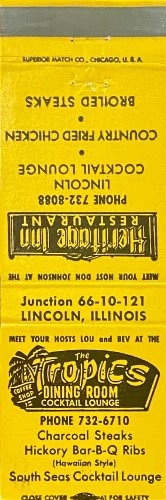
Vince Schwenoha opened The Tropics in 1950. He once lived in California so he was inspired to add tropical palms to the Illinois flatlands. Lou and Bev Johnson bought the property in 1955 and ran it for 40 years. After Iinterstate 55 took traffic from old Route 66, the restaurant changed hands and had several re-openings and closing before closing for the final time in 2004. The building was razed for a McDonald's in April 2017.
Some very collectible matchcovers from Route 66 are from businesses where the highway number of 66 is not printed on the matchcover anywhere. Often a street address printed on the matchcover places the business on the old road but in some other cases a source other than the matchcover is required to actually locate the business on Route 66. This may seem strange at first to Route 66 supporters but there are a couple of logical reasons why a business would not have "66" printed on its matchbook.
The first reason, and by far the most common one, is that the business primarily catered to local residents rather than to Route 66 travelers. This was most likely the situation in the larger urbanized areas through which Route 66 ran. Motels, because they targeted the traveling public directly, usually printed the highway number on their matchbooks. However many eating establishments and gasoline stations, while sometimes patronized by the highway-traveling public, may have principally served nearby citizens. In these cases a street address would be sufficient to remind local residents where the business was located. Businesses that had little to do with the traveling public (say, drug or grocery stores, banks, etc.) rarely listed the highway number on their matchbooks.
The second reason would be that the business found itself off of official U.S. Highway 66 once the highway was re-aligned usually to the interstate. This was often the case in the later years of commissioned Route 66 but it could also be the case for traveler-oriented businesses that were located in cities that were bypassed fairly early in the 1960s.
And finally, that leaves some examples where I can find no good reason at all why the business owner did not list the highway number as part of the locating description on their matchbook. In these cases it would seem to me that the owner should have listed the location on Highway 66. These situations are curious. What was the business owner thinking?
Here are eight front strike matchcovers (one from each Route 66 state) from businesses that we know were on Route 66 but the matchcovers do not explicitly say "66" on them:

I have no idea why Alice Lawrence did not have Highway 66 printed on her matchbook. After all by the 1960s this entire Bagdad complex existed to provide services for Route 66 travelers. Aside from a few railroad workers and mining company employees there were few locals to patronize the enterprise.

I like "Old Trails" almost as much as I like "66" in a business name. The Old Trails Garage probably did most of their business with residents of northwestern Arizona. The Old Trails Garage did not advertise gasoline for sale so it probably focused on the sales and service of Chevrolet automobiles.

Central Avenue was Route 66 in Albuquerque after 1937. Like many businesses along Central, most of the customers of Mom's Café were probably local residents. "Never play cards with a man called Doc. Never eat at a place called Mom's" - Nelson Algren from A Walk on the Wild Side.

There was no business in the tiny border town of Glenrio that was not on Route 66. (The post office was in New Mexico. This motel, café and gas station were in Texas.) I wonder why Homer Ehresman did not specifically locate his Texas Longhorn complex on either Highway 66 or Interstate 40.
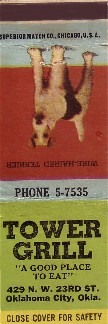
Oklahoma City had hundreds of businesses that were located on various streets that at one time or other were Route 66. But since they principally served local residents it is not unexpected that only their street addresses would be printed on their matchbooks.

The business of a clothing store would have been with locals so only the street address was needed. (But Wayne Troutner, the owner of the Store For Men in Winslow, Arizona, turned many Route 66 travelers into customers thanks to his many famous roadside signs.)

One postcard and at least two other matchbook designs explicitly locate Bob Miller's Restaurant on U.S. Highway 66 (Main Street). My guess is that this matchcover was printed after downtown Joplin was bypassed and many travelers stayed on Interstate 44.

Rossi's in Braidwood included a motel, cafe, and Sinclair gas station. The gas station was at the corner of US Highway 66 and Main Street and likely did much of its business with Route 66 travelers so I don't know why the highway number was not printed on these matchbooks.
Whereas some matchbooks from businesses located on Route 66 do not say "66" on them anywhere, some businesses adopted the highway number as part of their name. I am quite agreeable to the notion of naming a business with the double sixes. Below are eight examples (one from each Route 66 state) where the names are at least slightly different from each other. But here's a curiosity: despite the "66" in each of the names, only one of these eight matchcovers explicitly states that the business location was highway 66 (one says "Hi-Way 66"). The others let their names do the talking I guess. (Hmm, the 66 Supper Club in Joplin apparently did not wish to be patronized by military personnel. What's with that? Were they too rowdy?)


Matchcovers with photo-like Pictures are interesting because they combine some of the illustrative benefits of a postcard with the function of a matchbook. Alas, the resolution of the photograph, when printed using early matchcover printing technology and materials, is of much poorer quality than a picture postcard. Early photo matchcovers are not particularly common so they catch my attention. Below are eight matchcovers (one from each Route 66 state) from businesses that used a photo-like picture on their matchbook.

I've been to a drive-in before, yes, but to a "Car Cafe"? No! This must have been the action spot in Needles for a time. The saddle says "Always COOL". The photo is different in that it is a night-time view of the café and it shows several old late-1940s or very early 1950s-era automobiles huddled around the building.

The Painted Desert Trading Post is probably the most famous of all the so-called trading posts along Route 66. Built by Dotch Windsor in 1942, it was in operation until the late 1950s when US 66 was moved south and then later replaced by Interstate 40. This restored structure still stands along a lonely stretch of very old 66.

This Silver Spur Motel matchcover is a silver foil matchcover. Foil matchcovers were made by laminating a thin piece of fragile foil onto the cardstock substrate and then printing on it. This business chose a photograph of their roadside signboard to use for their matchbook but it does not show up very well.

The Ding How Restaurant owner chose a front view of their building with the interesting Chinese pagoda sign to the upper left. There is a photochrome postcard that uses a similar image. The last time I was through Amarillo the Ding How Restaurant was still there along what is now Amarillo Blvd. just west of the railroad tracks.

This Ranch House Cafe matchcover is a bit unique in that the proprietor used two photo images for this matchbook. On the front cover is a picture of the front façade of the business along with the street address for local patrons and on the rear cover is a detail picture of the signboard with the "On Highway 66" notation for travelers.

The Capistrano Motel in Baxter Springs was one of just a few motels along US Highway 66 in Kansas. This matchcover is different because the picture is on the front cover and the text is on the rear cover. Curiously, no text says "Capistrano Motel": the only mention of the name is in the hard-to-read sign in the picture.

The owners of the Vesta Court in Lebanon, Missouri, crammed a lot of text information on the front cover. The rear cover photo image came from a real photo postcard. It even has the photographer's handwritten title (the blurry white line in the street) that says "VESTA COURT - 3 Mi. E. Lebanon, MO on Highway 66."

Now here's a place that I wished I could have visited back in the Highway 66 days: the Hill Top Inn and Picnic Grove near Lemont, Illinois. It looks to be a cool, shady place along the highway. The picture appears to be of the building and the grounds. Perhaps it was a destination for Sunday drivers coming from Chicago.
Really Cool Route 66 Matchcovers
Here are eight of my favorite Route 66 matchcovers. I wish I had all of these matchcovers in my collection but I do not. (I had to "borrow" some images from others.) They are listed from west to east along Highway 66.

Wey Yim Lee emigrated from China and built a small café on the north side of Route 66 in about 1935. A Texaco gas station was added later. In the US Army during World War II, Wey Yim was called "William" by his fellow soldiers so Wey Yim or William was known as "Bill" when he returned to Amboy after the War. He re-named his business "Bill's" which he operated until about 1955. The service station and café went through several owners until I-40 was completed and the complex was closed and subsequently razed.

There are many matchcovers from Two Guns, Arizona, but nearly all appear to be from the late 1940s to the 1960s and promote the more modern gas station and coffee shop that existed then. This matchcover is much earlier and the neat thing about it is that it advertises "Mountain Lions & Gila Monsters" among other animals that were caged at the "Wild Animal Zoo" for which Two Guns was well known. The saddle even promotes "Cliff Dwellings" which may be a reference to nearby Walnut Canyon.

"Rimmy" Jim Giddings operated the store and gas station at the junction of US Highway 66 and the road south to Meteor Crater in the 1930s. The story is that he was quite the character and his intolerance for traveling salesman was legendary. The reference to "Salesman Time 5 Minutes" was to the length of time he would permit traveling salesmen to pitch their goods before he would run them out of his store. The tagline "Rough Service" suggests something other than a comfortable "Full Service" experience.

Ted Jones owned the Blue Swallow Courts when this matchcover was printed. (Here is another example of a matchcover from a prominent Route 66 business that did not have the highway number "66" printed on it anywhere.) Mr. Jones sold the Blue Swallow Courts to Floyd and Lillian Redmond in 1958. Lillian ran the Blue Swallow Motel for another 40 years. Later owners upgraded the motel while keeping the best of its retro charm. The Blue Swallow Motel was listed on the National Register of Historic Places in 1993.

Roy Rieves began construction of the Rock Café from local sandstone during 1936, finally opening it in 1939. A series of owners and managers operated the café over the later decades. The most notable owner, Dawn Welch, is from contemporary times. She bought the Rock Café in 1993 eight years after the official decomissioning of US Highway 66 and has owned it ever since. The Rock Café was listed on the National Register of Historic Places in 2001.

There are a number of different matchcovers from the Meramec Caverns but I like this one because it has the name "Lester Dill" printed on it. He calls himself "The Cave Man." Lester Dill purchased Saltpeter Cave in 1933 and re-named it the Meramec Caverns. A promotional wizard, he had crews paint signs on the sides of farmers' barns along the highways directing travelers to the Caverns and was one of the first people to create bumper stickers for visitors' cars.

The Bel-Air Drive-In Theatre was one of many theatres that once sat alongside Route 66. It opened in 1953 on Chain of Rocks Road just east of the bridge of the same name. A second outdoor screen was added in the late 1970s. The Bel-Air closed in 1987 and everything except the entrance sign was demolished in the 1990s. The entrance sign was finally removed in July 2018. I really like the detailed Googie-inspired artwork on this matchcover.

Known during the halcyon years as the Dixie Truckers Home, it was founded in 1928 at the intersection of US Highways 66 and 136 (once State Highway 119). It was named the Dixie to imply southern hospitality. Although the initial focus was on long-haul truckers, facilities were added so all motorists were welcome. This early matchcover is interesting and proof that in the very early years it was named the Trucker's Dixie Home. Today this is a Road Ranger Travel Center.
What's Printed on the Inside?
Some matchbooks were printed with text or an illustration on the inside surface of the matchbook cardstock. Inside printing was an extra charge so most business owners declined this option. Early inside printing was almost always done in a single color of ink, usually black, but other colors like dark blue, red or green could also be used. The different background shading of the inside images of the matchcovers seen below is due to the age or toning of the cardstock itself. Most early matchbooks were made with a lamination of a high-quality paper on the outside surface of the cardstock so the printing on the front cover, rear cover and saddle was of good quality. But the raw surface of the cardstock used in early matchbooks absorbed ink differently than the front side of the matchcover so most printing on the inside of matchcovers is of lower quality and consistency than printing on the outside. But in the later years matchbook manufacturers were able to use a higher quality of cardstock material that had a smoother, whiter finish and inside printing became just as readable as printing on the outside.
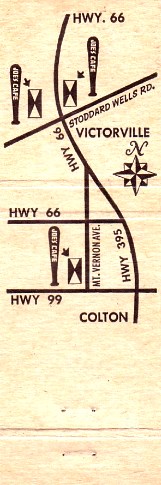
The highway mileage table was the most common convenience feature printed on the inside of a matchbook from a roadside business. A mileage table listed the distances from the town to other destinations along various highways. Other optional inside printing included text that could promote more features and services of the business itself or standard advertising artwork already prepared by the matchbook manufacturers. But custom-designed pictorial artwork paid for by the business owner could also be printed inside the matchbook. Below are eight diverse examples: the first one on the left has a highway mileage table, the next three from the left have text that further promotes the business (note the brief breakfast menu printed on one), the next two have locating maps, and the last two have "full-length" illustrations, one in the more common horizontal format and one in the less common vertical format.




Below are picture links to the other informational web pages and gallerys of Route 66 matchcovers and matchbooks.
Return to Route 66
Matchcover Home

Selected Themes
of Route 66
Matchcovers
Route 66 Full Length Matchcovers
Route 66
Matchcover Sets

Special Route 66
Matchcovers and
Matchbooks