Route 66 Matchcover Sets
A Set is a collection of matchbooks that were issued at the same time from the same business or industry. Matchbooks in sets from Route 66 roadside businesses typically had the same front cover and saddle text and artwork. Some could even have the same artwork on the rear cover too but what would make them a "set" then could be a different color implementation for the matchbook members of the set. Or alternatively the rear cover artwork would be different for each matchbook member of the set. A set comprises three or more covers but most sets had from five to twelve different members with five being a particularly common number of matchbooks for a set.
Even a beginning matchcover collector knows that it is quite common to find different color examples with the same matchbook artwork (exact same front text and rear stock cut and saddle cut) among two-color 20-strike matchcovers. By "two-color" I usually mean one printing color on a different color background. During the 1950s and 1960s many two-color 20-strike matchbooks were printed in sets with black ink over commonly five different color backgrounds. (Sometimes more than five colors were offered.) Some two-color 20-strike matchbooks were printed with a silver or gold ink over three to five different color backgrounds. But a few matchbook manufacturers changed things around and offered sets with five different printing colors over a white background. The key point is that the artwork itself was the same in all cases: just the colors were different. In a typical production order one-fifth of the matchbooks delivered to the customer would be one color combination, one-fifth would be another color combination, etc. That said, some matchbook manufacturers permitted the business owner to specify that they wanted their entire order of matchbooks to be delivered with just one particular color combination, not five. And, on the topic of color combinations, there were many business owners who by circumstance could only get their entire order of two-color 20-strike matchbooks implemented with one color combination, perhaps if they chose certain stock cuts. or metallic or luster colors, or embossed printing or a special background pattern (i.e., wood grain). Other sizes of two-color matchbooks (30-strike, 40-strike etc.) were usually ordered with just one unique artwork design during this period.
Some matchcover collectors do not consider different color combinations of two-color artwork a true "set" and some do.
Some comprehensive collectors like collecting all possible two-color combinations from a "set" from the same business. I myself do not collect any more than one example of a particular set of two-color artwork from the same business. However I do collect different matchcovers from the same business if the artwork on the rear cover is fundamentally different and that usually means the elements of the set are printed in multiple colors. (See farther down on this webpage.) Matchcovers with the same artwork except for different colors don't interest me too much and could otherwise potentially flood my albums with a lot of redundancy.
The easiest way to collect a complete "set" of matchcovers is to purchase or trade for an assembled set from another collector (duh!). I can tell you from experience that it can be tough to assemble a coveted set one cover at a time from nothing. Many years and a lot of patience can be involved in collecting sets from scratch.
Let's look at some sets from Route 66 businesses and begin with an example of the very common two-color 20-strike matchcover set.
Edgar Perkins was once president of the Rathkamp Matchcover Society. Acting as an agent for the Maryland Match Company he created his own series of matchbooks now known as Americana or Perkins Americana. All sets had the name "Americana" on them and an illustration of an American Indian. Most sets were styled similarly with a salute to the state on the rear cover. And most sets came in the same five background colors: pink, white, orange, yellow, and green. Over 200 sets were eventually created mostly during the years from 1957 to 1962. There is only one set from the State of New Mexico and it is the only set from Route 66 too. The set is from the Continental Divide as seen below. Unfortunately the matchcovers do not say "Highway 66" on them but they do say "town of Continental Divide, N. Mex.". Although there were multiple highways that passed over the Continental Divide in New Mexico, there was only one town named "Continental Divide" and it was on US Highway 66 between Gallup and Grants. Note that the hard-to-see text on this matchcover (i.e., "Here, rainfall immediately . . .") is a similar but abbreviated version of the printing that exists on the famous roadside highway sign at the Continental Divide, US Highway 66, New Mexico.


Multi-colored matchcover sets are more interesting to me and I do collect different matchcovers from the same business if the artwork on the front cover and saddle is identical (except sometimes for the colors) but the artwork on the rear cover is different and part of a set. The major matchbook manufacturing companies produced "stock" artwork for the rear cover in sets with themes like girls, hillbillies, nature scenes, patriotic images, safety slogans, dog breeds, etc. Matchcover collectors are familiar with these sets.
Pretty girls appeared in the catalogues of many matchbook companies soon after World War II. Most matchcover collectors refer to them as Girlie matchcovers but some matchbook companies officially referred to these sets as "Glamour Girls." Some companies commissioned the great pin-up illustrators of the day (Alberto Vargas, Gil Elvgren, George Petty and others) to provide or license their illustrations as matchbook art. Many of these early illustrations were also accompanied by a risque text which was often a double entendre or pun. The matchbook companies often issued these girlie illustrations in sets of five. The early drawn girlie artwork is obvious but later real female models were used as the basis of the artwork. These "live model" illustrations were initially printed in the primitive low dot density technology of the 1950s and 1960s which made them appear kind of like a blend of a photograph and a drawing but later in the 1960s and in the 1970s better photo printing proceses were used for matchbooks and the girls became much more life-like.
First, what is not a set? The El Patio Cafe and Cocktail Lounge on US Highway 66 in Flagstaff, Arizona, possibly had the most girlie sets of any business on Route 66. At first glance the five girlie matchcovers shown below may look like a set but they are not. In fact no two of the matchcovers are even in the same set! You have to look carefully and have additional knowledge to know that these five matchcovers are from five different sets. First, the two matchcovers on the left have the two-digit telephone number of 48 so they are different from the others. But the girlie illustration "This is no Gamble!" is from a different set than the illustration "A Hooked Lass!" (Note that the text "A Hooked Lass" is in a box and the "This is no Gamble!" text is not so that's a big clue that they are from different sets.) The next two matchcover images could be from the same set but they are not. A careful observer can see that the size of the text as part of the illustration is slightly different but otherwise you have to know which girl comics appeared in which sets. And finally the far right matchcover has totally different text and saddle printing so it is from an entirely different set. (I actually have a Match Corp. matchcover from a sixth girlie set that I don't show here.)


So what does a real Girlie set from the El Patio Cafe and Cocktail Lounge look like? Below is a true complete set:


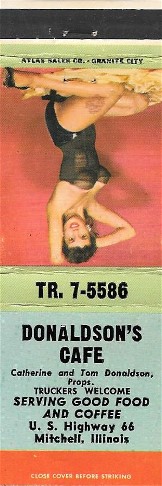
Catherine and Tom Donaldson owned Donaldson's Cafe on US Highway 66 in Mitchell, Illinois. (Mitchell is just across the Mississippi River from St. Louis and east of the famous Chain of Rocks Bridge.) They chose a later Girlie set of illustrations that were based upon the photographs of young models as opposed to the earlier artist-drawn illustrations. Live model illustrations became more common in the 1960s and usually were not labeled with risque titles as the earlier matchbooks were. (By the way, there is a hillbilly matchbook set from the Donaldson Cafe that has a different telephone number printed on the saddle. The hillbilly matchbooks were most likely distributed after these girlie matchbooks since the reference to the highway location is "Bypass 40 and 66.")


I know of three different girlie matchcover sets from the gasoline station at Two Guns, Arizona, but I am a long way from completing any them. (If you're counting, the three sets are from Monarch Match's Glamour Girl series from 1948, 1949 and 1951. All three sets say "Fire Up with Two Guns Gas" on the front cover and say "Save 349 Gas" on the saddle.) They seem to be very hard to find. But I do have a complete Two Gun Town Coffee Shop Hillbilly matchcover set from Monarch Match as seen below. The hillbilly sets that the leading matchbook companies offered in the 1950s and 1960s poked fun at hillbillies and their manner of speech and perceived intelligence and sophistication. The humor, like that of the girlie matchbooks, would be considered predjudicial and inappropriate today. (Hmm, a bit tongue-in-cheek, the coffee shop was "Located Directly Downtown Route 66 Two Guns, Arizona". Downtown? Really?)


Superior Match Company offered a number of Americana matchbook sets in the 1950s. The first sets that were offered from about 1950 to 1956 consisted of eight different color illustrations per set. The later sets from 1957 to about 1960 had only five illustrations per set. The owner of the Elite Courts in Amarillo, Texas, ordered the 1951 Americana matchbook set from the Superior Match Company.


Texaco was founded in 1902 as the Texas Company. It was the first gasoline company to have retail gas stations in all fifty states. Texaco once authorized a nice set of artwork for matchbooks in affiliation with the Diamond Match Company. Each stock cut on the rear cover promoted a product or service of a Texaco gas station itself. The owners of Texaco gasoline stations could order matchbooks with this attractive and colorful artwork from Diamond. Bob and Letha Peart, owners of the Truxton Buffet in Truxton, Arizona, dispensed Texaco gasoline to motorists and they ordered a Texaco set from the Diamond Match Company. (By the way, there is at least one other different Texaco artwork set with different stock cuts for the rear of the matchbooks that Diamond produced during a different time period. And there are several completely different Texaco sets that were made by Universal Match Corp. too.)


Below are picture links to the other informational web pages and gallerys of Route 66 matchcovers and matchbooks.
Return to Route 66
Matchcover Home
Introduction
to Route 66
Matchcovers

Selected Themes
of Route 66
Matchcovers
Route 66 Full Length Matchcovers

Special Route 66
Matchcovers and
Matchbooks